Posts

Showing posts with the label India

23 Scott Lane, Kolkata
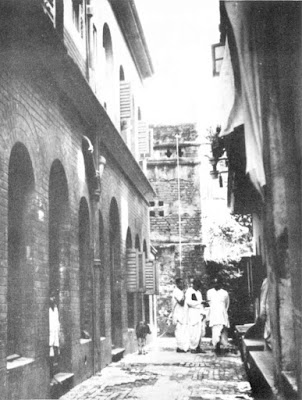
Image
Aurobindo Ghose (Sri Aurobindo) was born on 15 August 1872. He was an Indian nationalist, poet and yogi . Many years later, India became independent on 15 August 1947, freeing herself from the atrocities of the British empire.  Sri Aurobindo was one of the first Indian Nationalist who stated clearly that the entire nation of India ( Akhanda Bharat ) should work together to free themselves from the British Colonization.  He resided at many locations in Calcutta including 23, Scott Lane.  I visited 23, Scott Lane in 2020. The building is located at the end of a narrow lane behind Bangabasi College (amidst Baithakhana Bazar in Sealdah ), somewhat hiding and not visible from the main street. Initially, I failed to pinpoint the exact location of this building as Google Maps clearly betrayed me and the house numbers in this region don't follow a linear order. Local people in this area consist of local residents, businessmen, publishers and wholesale dealers having scanty id...

The Story of a Forgotten Orientalist of Bengal: Annette Susannah “Akroyd” Beveridge (1842-1929)

Image
The contribution of Annette Akroyd   to women’s educational reforms in Bengal is largely forgotten. She was born December 13, 1842, in Stourbridge, England to William and Saran Akroyd. Anette was a noted British Orientalist and a Victorian reformer. She was conservative and opposed to the Women’s Suffrage Movement ( the right of women to vote in elections by law).  To this end, she  served as the secretary of the anti-women’s suffrage league in England. Educated in Bedford College, Annette was very well-prepared to teach with her pragmatic no-nonsense outlook. Annette Akroyd with the students of Hindu Mahila Vidyalaya, 1875.  From Henry Beveridge’s India Called Them: 1947 Annette traveled to Calcutta, India in 1872 upon invitation from Keshub Chandra Sen, a notable leader of the Brahmo Samaj, a Hindu reformist sect . Sen wanted Annette to promote non-sectarian education to Hindu women. Within a year, she founded the “Hindu Mahila Vidyalaya”, located near Beniapukur L...

The Orthodox Schools of Hindu Philosophy

Image
  Introduction The concept of salvation is ubiquitous across most religions. The primary goal of all religions is to guide their followers to salvation using specific laws and techniques. In the Indian subcontinent, Hindu philosophy proposes that the Ultimate Truth can be realized by following the six schools of salvation (or,  Darshanas ). These schools belong to the orthodox ( astika ) classification because they accept the Vedas as a supreme source of knowledge. Conversely, the heterodox ( nastika ) schools of philosophy reject the Vedas. These include Buddhism, Jainism, Charvaka, and others.  In this essay, I have only focussed on the orthodox classification. The Orthodox Schools of Hindu Philosophy   Overview of the Six Systems: 1.  Nyāya This is the school of logic headed by Gautama. In India, this school flourished in the Nabadwip region of Bengal. Nyāya  focuses on the logic to delve in to the root of the problem using sixteen categories namel...